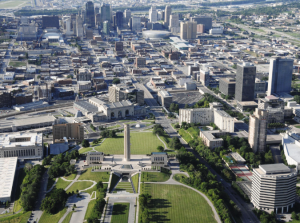
Kansas City’s grand boulevards, lush green parks, and iconic fountains didn’t happen by accident—they were part of a visionary plan shaped by the City Beautiful Movement, a national trend that swept through the United States in the late 1800s. While cities like Chicago made headlines for their monumental architecture, Kansas City quietly became a model for urban beauty thanks to the work of landscape architect George Kessler, who laid the foundation for the park and boulevard system we still enjoy today.
How the City Beautiful Movement Transformed American Cities
The City Beautiful Movement emerged in the United States during the late 19th and early 20th centuries as a response to overcrowded tenement housing, poor sanitation, and deteriorating city conditions caused by rapid industrial growth. Reformers believed that beauty in public design could elevate the moral character of citizens, foster civic pride, and create more harmonious communities. The movement gained momentum after the 1893 World’s Columbian Exposition in Chicago, where architect Daniel Burnham and landscape designer Frederick Law Olmsted created the “White City”—a symmetrical, neoclassical fairground accented with promenades, fountains, and grand architectural harmony.

The White City” at the 1893 World’s Columbian Exposition in Chicago, a model for the City Beautiful Movement’s vision of public beauty and civic order.
Image Source: Smarthistory
Chicago later applied these principles in its development of Grant Park, a lakefront greenspace that would eventually house the iconic Buckingham Fountain.

Image Source: Visit to Chicago 2025
In Washington, D.C., the 1901 McMillan Plan was directly influenced by City Beautiful ideals. It transformed the National Mall into a formal, symmetrical landscape framed by civic buildings and public monuments. One centerpiece of the plan was Union Station, designed to create a majestic first impression for visitors entering the capital by rail. These projects weren’t just aesthetic—they were designed to shape how people felt about their cities and their role within them.

Washington, D.C.’s Union Station was designed to impress visitors arriving in the nation’s capital—and it still holds up. Built between 1909 and 1932 as part of the City Beautiful vision, it combined grandeur and function in true Beaux-Arts style.
Image Source: Library of Congress
Enter George Kessler: The Man with the Master Plan
In 1893, landscape architect George Kessler unveiled a bold new plan that would transform Kansas City from a patchwork of disconnected neighborhoods into a city of flowing boulevards, vibrant parks, and scenic greenways. His vision wasn’t just about beautification—it was about structure, movement, and access. Kessler believed cities should feel intentional, not accidental. Instead of isolated parks, he designed a citywide system where tree-lined boulevards connected public spaces, and natural features like hills, rivers, and open vistas were woven into the experience of moving through the city.
Kessler’s work gave us landmarks we still treasure today—The Paseo, Penn Valley Park, and Swope Park—places designed not just for aesthetics, but for everyday life, rest, recreation, and civic pride. His plan brought Kansas City into the national spotlight as a model for urban design that balanced beauty with practicality.
Key Figures Who Brought the City Beautiful Movement to Kansas City

George Kessler – Landscape architect who designed the city’s first connected park and boulevard system in 1893.
Image Source: WikimediaAugust Meyer – Industrialist and first president of the KC Park Board, he championed the idea that parks and boulevards could transform public life.
Image Source: WikimediaAdriance Van Brunt – Architect behind several boulevards and the dramatic stone entrance to Swope Park. Image Source: MO Valley Special Collections William Rockhill Nelson – Newspaper magnate who used The Kansas City Star to rally public support.
Image Source: WikimediaJC Nichols – Developer who embraced City Beautiful ideals in his residential planning, using curving streets, green spaces, and architectural harmony—most notably in the Country Club Plaza and surrounding neighborhoods.
Image Credit: Wikimedia


Their work laid the foundation—literally—for a city that valued beauty, connection, and pride of place. But Kansas City didn’t stop with parks and boulevards. Over time, the movement toward urban elegance took on a more decorative (and dramatic) flair. Fountains began appearing throughout Kansas City—first as practical water features, then as dazzling symbols of civic pride and public art. What started as a nod to European cities quickly evolved into something uniquely Kansas City.
The Rise of the City of Fountains
As Kansas City grew into its new identity—structured by parks, stitched together by boulevards, and framed by civic vision—it didn’t stop at green space. The city began to embrace a more ornamental expression of public beauty: fountains.
At first, they were practical—watering troughs for horses, cooling public areas, or adding a touch of calm to busy intersections. But over time, Kansas City took a cue from Europe, where fountains were celebrated as expressions of art, identity, and civic pride. By the mid-20th century, they had become part of the city’s character: elegant, abundant, and often tucked into the most unexpected places—from pocket parks to plaza courtyards.
The city’s most iconic water feature, the Mill Creek Fountain (formerly known as the J.C. Nichols Memorial Fountain), became a defining landmark—its dramatic bronze horses charging through sprays of water, marking the entrance to the Country Club Plaza and anchoring Kansas City’s visual identity.
But it was a trip to Rome in the early 1970s that truly changed the course of Kansas City’s fountain story.
Harold Rice, a Hallmark Cards executive, and his wife Peggy were so inspired by the artistry and reverence for fountains in Rome that they returned home with a big idea: Kansas City already had hundreds of fountains—why shouldn’t it become America’s City of Fountains?
Harold didn’t waste time. On June 27, 1973, he gathered four civic and cultural leaders—John W. Lottes of the Kansas City Art Institute, Jeannette Lee of Hallmark, Robert J. Wharton from First National Bank, and attorney Eugene C. Hall—and held the first board meeting of the City of Fountains Foundation in downtown Kansas City. Their mission? To protect, preserve, and promote the city’s public fountains as lasting works of civic beauty.
Since that day, the Foundation has grown into a powerful force behind Kansas City’s fountain culture. Today, it holds endowments for roughly 30 fountains, sculptures, and monuments—managing funds for restoration, conservation, and sometimes even helping advise on new fountain locations or relocations.
With more than 200 fountains across the metro, Kansas City now proudly claims the title of City of Fountains—second only to Rome, but first in the hearts of its locals.
Fountains Through the Years: Kansas City’s Timeline in Water and Stone

The oldest public fountain still in operation in Kansas City.

This elegant Italian-imported seahorse fountain anchors one of KC’s most scenic roundabouts.

KC’s most iconic fountain, installed in 1960 using bronze sculptures from a Long Island estate.

Dedicated in 1972, these family-friendly fountains are choreographed and fun to watch.

With 49 jets, this dramatic fountain runs year-round—even in the snow—and lights up the Northland.

A powerful tribute to KC’s fallen firefighters, featuring bronze figures and cascading water.

Featuring six bronze children at play, this joyful fountain celebrates youth and joy.

Dedicated in 2001, this choreographed modern fountain honors H&R Block co-founder Henry Bloch.

A peaceful fountain anchoring KC’s most iconic rose garden, perfect for strolls and ceremonies.
Fountains, Forever Kansas City
The City Beautiful Movement may have started as a response to the grit and chaos of America’s early cities—but in Kansas City, it became something more. It sparked a civic identity rooted in beauty, public space, and shared pride. Over a century later, that legacy lives on in every boulevard curve, every park bench, and every fountain spray that catches the afternoon sun.
Our fountains aren’t just decorative. They’re declarations—that we value art, gathering places, and the soul of a city built for people. What began as a movement has become a mindset. And it’s why, here in Kansas City, beauty still belongs to everyone.
So whether you’re discovering these landmarks for the first time or seeing them with fresh eyes, remember: you’re standing in a living legacy. One shaped by visionaries, sustained by community, and still flowing strong.
Come Tour With the Ultimate Fountain Fanbassador
Want to experience these stories where they actually happened? Join me—Kansas City’s resident Fountain Fanbassador—on a guided tour that brings our history, parks, and fountains to life. Whether you’re a lifelong local or just KC-curious, I promise you’ll never see the city the same way again.
👉 Book your tour now and let’s go make a splash.